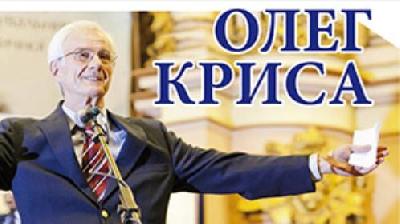
The violin phenomenon of Oleg Krisi
The famous Ukrainian violinist Oleg Krysa (a student of teacher Konstantin Mikhailov and legendary professor David Oistrakh) has been captivating and surprising the world musical community with his performing skills for more than half a century. His surprisingly grandiose repertoire encompasses violin masterpieces of the ancient Italian heritage, the Baroque era, Viennese classics, romantic composers, the brightest examples of 20th-century music, and the most iconic works of Ukrainian composers...
The famous Ukrainian violinist Oleg Krysa (a student of teacher Konstantin Mikhailov and legendary professor David Oistrakh) has been captivating and surprising the world musical community with his performing skills for more than half a century. His surprisingly grandiose repertoire includes violin masterpieces of the ancient Italian heritage, the Baroque era, Viennese classics, romantic composers, the brightest examples of 20th-century music, and the most iconic works of Ukrainian composers. His interpretation of chamber works, large concert and symphonic forms, and violin miniatures are exceptionally close and perfect to him. And in everything he is characterized by stylistic perfection, sophistication, grace, and filigree of artistic craftsmanship. He performs with the best conductors and orchestras in the world, and his unsurpassed partner was his wife, the outstanding pianist Tatyana Chekina. The posters of the most famous concert halls in the world, reviews, and an extensive, grandiose discography testify to the musician’s inexhaustible potential.
Oleg Krysa demonstrated the greatness of his artistic figure with an incredible musical marathon “History of the Violin Concerto”, which took place in Lviv in October and December 2015, where the evolution of this genre over 300 years was presented. This project consisted of four “Philharmonic Evenings” and included the performance of 12 of the most representative examples of Concertos for Violin and Orchestra. It is difficult to immediately name a concert artist who would dare to realize this idea in such a short time and at such a high “reference” level.
The first concert (October 17, 2015) consisted of exceptional works – from Baroque origins to the classical peak.
In the Violin Concerto in E major by J.S. Bach, Oleg Krysa revealed an exquisite baroque style, a filigree lightness of lines, a majestic sacred cantilena in the second part and brilliant virtuosity in the finale.
The next was a unique opus by V.A. Mozart - Violin Concerto in A major KV 219, where the demonstration of virtuoso qualities is combined with melody in the spirit of Italian cantilena, but the refined differentiated bow technique dominates. Here the Soloist was unsurpassed in classical articulation and jewelry touches, in the picturesque melismatics and lyrical poetics of the second part, and in the final Rondo, lightness, flight, improvisation, exceptional imagery and unexpected diversity between the refrain and episodes caused the listeners tremendous admiration and pleasure.
The final piece in the program was a brilliant masterpiece - Concerto for Violin and Orchestra in D major op.61 by L. van Beethoven. This is a large-scale symphonic work with a tense emotional tone, where the virtuoso brilliance does not overshadow the philosophical depth of the idea and the lyrical nature of the solo part. The innovative combination of classical and romantic features, where the role of the minor is significant with a general major inclination. In this work, soloist Oleg Krysa recreated the scale, depth and richness of images, the intensity of the thematic development and brought the content of the concert not to demonstrative brilliance, but to the disclosure and affirmation of the main idea through the dialogue of the solo instrument and the orchestra. The performance of the very complex Cadenza by F. Kreisler to the first movement, in particular the episode where the sound of the Main and Secondary parts is simultaneously superimposed, attracted special attention and admiration.
Oleg Krysa's performance partners in this concert were the chamber orchestra “Virtuosos of Lviv”, concertmaster Volodymyr Duda, conductor – Serhiy Burko.
The second stage of the violin “marathon” on October 23, 2015. was the performance of concertos from the Romantic era.
Concerto for Violin and Orchestra in G minor, Op. 26 by Max Bruch, brilliantly performed by Oleg Krysa, enchanted the audience with its romantic sublimity, melodic sincerity, especially in the Second Part, pathos, pathos, brilliant reproduction of the solo part with spectacular technical techniques in the finale.
Concerto for Violin and Orchestra in E minor, Op. 64 by Felix Mendelssohn-Bartholdy continued the musical celebration of Oleg Krysa's art, who exceptionally gracefully and perfectly showed virtuoso skill and brilliance, subdued by the disclosure of lyrical-dramatic, dreamy and contemplative images. This should be noted in Oleg Krysa's interpretation, especially of the second part - Andante with its unique cantilena beauty of sound. The main theme is characterized by a song-like, broad melodic line. The sound of the soloist's violin was fascinating when the intonation of a new theme appeared in a two-part presentation against the background of tremolo figurations that play the role of harmonic accompaniment. In the climax zone, the soloist reached the apogee with his sound when octaves appeared, which brought a pathetic shade. Gradually, the excitement disappears, and the main theme Andante sounds even more transparently and contemplatively in the solo violin. Concentrating his attention on the perfect sound of the cantilena with its unique vibrato in lyrical episodes, Oleg Krysa creates conditions for a brightly contrasting perception of the final part. Perfectly feeling the musical form, he exceptionally elegantly performs a poetic lyrical transition (Allegretto non troppo) to the finale.
The finale - a rondo-sonata (Allegro molto vivace) - Oleg Krysa performs with his inherent graceful humor, festive, sublime color. There was a general admiration of the audience for the amazing ease and enchanting skill of the right hand in mastering the bow strokes.
The triumphant conclusion of the second stage in the cycle “History of the Violin Concerto” was the performance of the famous Concerto for Violin and Orchestra in D major op.77 by Johannes Brahms. This is a kind of center of the entire genre of the violin concerto, its most perfect example, in particular the first part – Allegro non troppo. In this work, the violin part is saturated with significant technical difficulties that do not have the character of a virtuoso end in itself, but organically arise from the musical concept of the work. They mainly affect the violinist’s left hand: double notes, long interval jumps, atacca of sounds in a high register, etc. In the First Part, the famous Oleg Krysa demonstrated a vivid example of Brahms's Allegro sonata with his performance, where an intensification of the action of violin expressive means was observed while preserving their academic classical functional direction.
The sharpness of intonation, harmony, activity of rhythm, texture, form, contrasts, the perfect balance of saturation and rarefaction of sound, laconicism and exhaustiveness of thought, the absence of general episodes, the through development in this work in his interpretation are simply impressive. In his convincing performance, epic strength, poetic lyrics, dramatic pathos and relief of contrasts are observed. In the interpretation concept of the soloist, a very interesting chain of stylistic associations is observed. Namely, the sound of dense chords in the solo violin will connect the audience's imagination with J.S. Bach's Chaconne; rhythmic energy, the predominance of fourth intonations remind of L. Van Beethoven.
It should be noted that in Oleg Krysa's work, the lyrical principle in his violin romantic-subjective expression becomes the internal driving force of his dramatic development, all dramatic impulses are prepared by deep processes in the lyrical sphere. In his performance, the beautiful theme of the Soloist's Side Part becomes the pinnacle-goal, a true Brahmsian "love theme", balancing on the verge of reality and sensitive ghostliness, with its inherent desire to disappear, to dissolve in the flying motifs of the violin in his hands. In this work, Oleg Krysa pays special attention to the perfection of the left hand technique. The rich use of accented wide jumps, double notes and various chords distinguishes its own expression and transparency, and not virtuosity as an end in itself. His cantilena is distinguished by its sincere expressiveness – gentle and transparent in the upper register, softly melodious in the middle, deep and rich in the lower. The extremely diverse solo part reveals a wide range of expressive and technical possibilities of the instrument.
The violin participates in the representation and development of the entire thematic material on an equal footing with the orchestra – they “diverge” only in opposite limits: in the opposition of the epic orchestral and lyrical “vocal” variants of the thematic material.
The performance of the Cadenza was effective, meaningful and exceptionally close to the original source.
Oleg Krysa’s violin in the Adagio reigns supreme, but its introduction is delayed by the full conduction of the theme by the solo oboe, which creates the effect of “alienation” and contributes to even greater expressiveness of the cantilena. The soloist's ornamental variation of the theme brings into it a touch of exquisite fragility and improvisational freedom, which contributes to the naturalness of the transition to the middle part, where the figurations acquire an even more lyrical character, and later also dramatic expression. The through-line of his performance of refined figurations continues in the reprise, which begins as a duet of the oboe and the violin dominating it. The combination of simplicity and elegance, wide melodic breathing and clear relief of form with detail, intonational unity, with a through-development of motives reaches in the Adagio the pinnacle of perfection, inherent in Oleg Krysa's performing manner.
The tradition of affirming vital energy embodied in the elements of folk dance has been observed in the final parts of instrumental concertos since the times of J.S. Bach and A.Vivaldi. The violin masterpiece by J. Brahms, performed by Oleg Krysa, demonstrates this most vividly with its finale Allegro giocoso, ma non troppo vivace and receives the most joyful and powerful reflection. The sound of his violin is inextricably linked with the expression and passion of Hungarian melodies. The fiery ardor of the dance in the finale, embodied within the framework of the rhythmic and structural organization, does not lose its characteristic laconicism and perfect clarity of form. The onslaught of energy in the side part, emphasized by the violin octaves, enhances the triumphal-heroic character of the music, shading it with the modest, gentle lyricism of the central episode and recalling a certain kinship with the second part, especially in the episode of the violin and oboe duet. In the coda, where the main theme is subject to Brahms' favorite variational metrorhythmic modifications, a "chromatic motif" from Adagio suddenly flashed. The epic power of the tutti is reminiscent of the first movement. The Adagio and finale organically complement it, expanding the “panorama of the world” to true encompassingness in Oleg Krysa’s interpretation.
In this symphonic concert, the successful embodiment of these unsurpassed works was performed by the Academic Symphony Orchestra of the Lviv Philharmonic, conducted by Serhiy Khorovets.
Analyzing the performance of the Violin Concerto with Orchestra by J. Brahms, it is necessary to mention the most spectacular, closest to the original source, Cadenza by the outstanding violinist J. Joachim, which was created at the time of writing the concert itself, since the author himself turned to him for performance advice. The Cadenza concisely covers almost all the thematic material of the first part, extremely subtly and organically conveys the spirit and mood of this work. In the interpretation of Oleg Krysa, it is distinguished by exquisite skill in terms of unsurpassed violin technique and exceptionally perfect interpretation.
In the third stage of this unforgettable violin "marathon", which took place on December 3, 2015. performed: Concerto No. 1 in D major, Op. 19 for violin and orchestra by S. Prokofiev, Concerto for violin and chamber orchestra No. 3 by A. Schnittke and Concerto for violin and orchestra in D major, Op. 35 by P. Tchaikovsky.
The First Concerto for Violin and Orchestra, Op. 19 by S. Prokofiev is one of the most striking and innovative works of 20th century music. This is a three-part concerto with an unusual arrangement of parts: the first and third parts are dominated by moderate melodic moods, and the middle part is a fast virtuoso scherzo. The overall concept of the work is lyrical, thanks to the main part, which is repeatedly repeated, opens and ends the first part, and then sounds in expansion at the very end of the finale of the concert. In his performance of this work, Oleg Krysa exceptionally gracefully recreated the lyrical melody of early S. Prokofiev. In his interpretation, it is beautiful with its strange, peculiar beauty. As it should be, it is not characterized by psychological tension and saturation, it is very melodious, exquisitely simple, the melodic line of development is very clear and distinct. He reveals the nature of the violin with the greatest effect, the solo is not opposed to the orchestra, but merges with it, attaching great importance to timbre. The soloist finds a sound that corresponds to the poetic and dreamy character, thinks in "long melodies", perfectly listening to the last notes in the leagues, which are the connecting links in the phrase. The real delight here is caused by his unsurpassed vibration and changes of the bow, as well as the relief dynamic distribution of the development of the melody, the voicing of each note, especially the climax.
The first part of the cycle is built on a sharp change of contrasting images. The contrast to the main part is a virtuoso connection with inlaid trills and modulating passages. The secondary theme is fabulous, fantastic, scherzo in nature. How elegantly, masterfully and naturally O. Krysa managed to do this, particularly in those episodes where a capricious rhythm appears, where there are forschlags, chromaticisms, accents, sharp but elegant strokes with a slight vibration of sounds.
Development - themes are transformed and acquire features of sarcasm and grotesque. The fanfare beginning of the development (fourths-fifths) gradually transitions into an energetic, pulsating folk scene with “buffoonish” undertones in the orchestra, pizz. violins – imitation of balalaika. Here, soloist Oleg Krysa masterfully creates gradations of growth, using various technical means from wide-range passages to double notes. Dynamics and tempos are constantly increasing, and what a sharp, marked, but not “dry”, stroke he has near the pad. It should be noted what masterful elements of hidden polyphony he demonstrated, there is no manifestation of excessive sound forcing anywhere, and exceptionally accurate intonation! In the episode of the violin solo meno mosso, after a stormy development, the soloist revealed a unique bow handling when switching to a slow tempo and calm vibration at the dynamics of R. In the shortened reprise, the lyrical mood returns, only the main theme is heard, which runs in the flute at a slower tempo compared to the exposition, and the violin performs tender passages con sordino in the upper register. Oleg Krysa reproduced them with a small segment at the end of the bow, imperceptibly changing the legato stroke to the detachment (double stroke) and vice versa in the nuance of RR. The crystal-clear intonation was fascinating, especially this applies to the semitones in the high register. The coda sounded like a miracle of instrumental color and an expression of deep poetic feeling.
The second part of the concerto is Vivacissimo, a brilliant scherzo - a five-part rondo, a kind of perpetum mobile. An energetic, clearly rhythmic melody from chromatic sequences rapidly soars upwards, light and fast passages, a change of pizz. and arco, flageolets accompanied by flute and strings, remotely imitating the sound of a balalaika. Soloist Oleg Krysa, with incredible youthful enthusiasm, played a short, thick bow (middle-pad) almost on the spot. He played the passages with light fingers, a small section of the bow, the whole theme sounded compact, very clearly rhythmic, intonation filigree. In this short theme, S. Prokofiev used a large number of various sharp strokes: accents, dots, spicato, marcato, ricochet, pizz. with arco, short leagues with dots and accents. It should be noted that the main theme is a joke, and the episodes are already sharp irony. How colorful, brilliant and convincing it all sounded. The first episode is sul G, a staccato marcatissimo stroke near the pad, and the soloist's long interval jumps turned out to be with perfect accuracy of hit. The second episode is sul ponticello, con tutta forza. The theme is somewhat mechanical in composition, nevertheless, it turned out to be surprisingly expressive phrasing in Oleg Krysa. Throughout the Scherzo, which takes place in continuous motion, the soloist demonstrated true artistic violin virtuosity.
The finale - Moderato again returns us to the world of lyrics. It sounded balanced, life-affirming. The soloist showed great skill in developing the melodic line, because it has a very wide range (the length of the last theme is 23 bars!). Oleg Krysa thought here in an incredibly long phrase-line, logically built it, leading it to the climax of the finale. The thematic material sounded smoothly, without a sense of bow changes, the transitions in the left hand are very melodic. The violin scales sounded perfect and colorful (Prokofiev's irony over the aesthetics of the time), against which the ostinato theme of the tuba, double basses and cellos sounds. A real symphonic development gives a special drama to this climax. In the coda, the main theme of the third movement in the solo flute is combined with the main theme of the first movement in the violin, and the thematic arch unites the entire concert. The most important thing in the coda is that the soloist revealed an exquisite timbre of sound with exceptional intonation, which corresponded to the elegant mood, inner harmony and poetic contemplation.
The next work chosen by Oleg Krysa in this program was Alfred Schnittke's Third Concerto for Violin and Chamber Orchestra, dedicated to Oleg Kagan. In terms of emotional orientation, it is comparable to a number of works belonging to the memorial genre, mourning and the tragic perception of life are the basis of its content. In this sense, this opus in A. Schnittke's work can be put on a par with his "Requiem", the Piano Quintet, next to the late works of D. Shostakovich (in particular, with his Viola Sonata) and with the Sixth Symphony of P. Tchaikovsky. These parallels are not accidental. In the Third Concerto, the tragic is extremely acute, hence the peculiarities of the composition and dramaturgy. In contrast to the progressive, "ascending" dramaturgy (as, for example, in Concerto grosso No. 1, in the Quintet), in the Third Concerto there is rather a "descending" line of development, with a tempo and dramaturgical slowdown towards the end. The three parts of the cycle (the composition of the concerto is a "poetic" form still associated with the romantic tradition, combining the features of sonata and cycle) are three stages of the "drama": Part I (also known as the sonata exposition) - the beginning of the action, Part II (development) - the action and Part III, the finale (reprise of the sonata form) - the epilogue, the denouement. But at the same time, Part III, in which no "events" take place anymore, turns out to be the most significant, the final one in terms of dramaturgy. And although it lasts about the same as Part I, due to the lack of contrasts from which Part I is built, the finale seems more prolonged: it is a farewell that one wants to last forever. There are three dramatic spheres in the concerto. Two of them are antagonistic, on which the dramaturgy of the work is based; the third appears as a result of this opposition. Oleg Krysa has exceptionally built an interpretative concept, creating an extremely sophisticated dialogue between the soloist and the orchestra, which, according to the romantic tradition, can be deciphered as a conflict between the individual consciousness of the person and the environment hostile to him. The conflict of the leading spheres operates on three large-scale levels. The first contains the soloist's cadence and the section in which the wind instruments are exhibited - this is the beginning of the action (conditionally it can be called an introduction preceding the action); compositionally - this is the main theme of the sonata exposition. The second level is the entire exposition (Part I of the cycle) - the first stage of the action, the collision of the main dramatic spheres, which leads to the appearance of the third. The third level is the entire cycle, where after the exposition of the main conflict in Part I (exposition), the stage of action (counteraction) follows, leading to the climax (Part II — development) and the conclusion, the epilogue (Part III-reprise-coda). The first clash of antagonistic spheres occurs in the introduction: a solo violin cadence and then a section in which only wind instruments participate. Soloist Oleg Krysa exceptionally figuratively presented the timbre of the solo violin, which is associated with the human voice, an individual, personal beginning. In this case, a quarter-tone trill (actually, a written vibrato) in combination with sharply expressive chromatic motifs makes his individual violin intonation extremely nervous, emotionally naked. The timbre of wind instruments adds a completely different flavor to the sound of the music, the involvement of which is imperiously interrupted by the passionate recitative of the violin. Here, the antagonistic relationship between two contrasting timbre groups is particularly noticeable, especially the solo string and wind instruments - this is a compositional dramaturgical device. Thirteen wind instruments (by the way, they were, as expected, located in the foreground of the stage) are opposed by a string quartet, which is introduced only at the border of the P and III parts and then participates in the III part. Up to this point, only the solo violin of Oleg Krysa is forced to "hold back the pressure" of the wind group, and here the dramatic tension has reached its maximum sharpness - the piercing, trembling voice of the violin and the four-octave dead unison of the low wind instruments. It should be noted how the soloist recreated the smooth, wavy line of the violin cantilena - and clearly verified the "geometric" conquest of the strictly harmonious space of the sound of the wind instruments, which expands vertically. Extreme individualization, emotional expressiveness — in one case, and dispassionate objectivity — in the other. The stream of sounds, which has burst forth as a passionate appeal, comes up against an impenetrable wall that nothing can shake. The living and the non-living, life and death — the problem is inexhaustible and, probably, insoluble.
After the extremely dramatic, sharply chromatic material of the main and connecting parts, everything suddenly freezes, and in this silence, especially emphasized by the mournfully drawn-out pedal of the French horn, the voice of the violin is barely audible. Oleg Krysa, with his unsurpassed violin sound, created a contrast so strong and unexpected that this theme in his performance became the center of the exposition. The melody is extremely simple - the motifs, separated by pauses, expand symmetrically. The theme sounds in the solo violin, as in the initial cadence, but here it has a completely different genre appearance - it is not an expressive recitative, but a pure, almost "childish" humming in half voice. With his rhythmic will, the soloist adds a natural breath to the symmetrical expansion of the motifs-replies. Refined simplicity, structural clarity and clarity are the main features of the sound of his violin and exquisite interpretation, its natural beauty gives rise to a feeling of vulnerability and fragility. In contrast, a gloomy chorale of brass sounds, creating an emotional contrast. Here, there are no protesting intonations in the solo violin part, but it is the main "actor", the personification of individual consciousness. Soloist Oleg Krysa fills the violin part, its thematics with inexhaustible emotional richness, and in the sharp and tense melodism he puts so much heartfelt pain, so much ethically and aesthetically high, that the dramatic accents shift - a tangible "quantitative", "qualitative" and moral superiority.
From the very first sounds of Part II, a terrifying, ghostly world sets in: cold, gloomy, hard, prickly or endlessly, terrifyingly drawn emotional sonority, in which there are no living human intonations, no living breath, no “air”. This is a soulless machine that grinds everything around, but it is opposed by individual consciousness, and in this “heroism of despair” there is a tragic height that keeps in constant tension. The three large sections of the part correspond to different stages of the struggle, consistently and steadily advancing towards catastrophe. The first demonstrates a sharpened version of the expositional relationship of the spheres, which here retain their individuality, integrity and a certain independence from each other. The activity of each of the confronting spheres reaches its limit: the chromatically sharpened lines of the violin are answered by the chromatic chords of the wind instruments, absorbing an ever-increasing sound space. The extreme polarization leads to a qualitative shift - the interaction of the spheres begins, their intonation interpenetration. "Shadows", "doubles" of the violin voice from the wind group appear, which distort the intonations of the violin. In turn, the violin part also changes under the influence of the second sphere - a process of intonation deindividuation takes place in it. The second section is transitional, but emotionally extremely tragic. In soloist Oleg Krysa, the recitative of the opening cadence arises illustratively and figuratively against the background of second-minute "creeping" figures in a very high register, in the context of the intonation "depersonalization" of the development, it becomes the strongest factor of expressiveness. This is a passionate plea for the unfulfilled, quarter-tone trills sound very plaintive and doomed. The third, final, stage of the development is marked by the author's remark of a scherzando, which refers to the violin part. This is an important turning point - a genre transformation takes place, which now acquires the features of a gloomy grotesque scherzo, something like dance macabre. Against the background of chromatic chords, ostinato repeated in a jazz asymmetrical rhythm, a distorted, devilishly "wriggling" melody appears in the violins, in the sharply rhythmic pattern of which it is impossible to recognize the main and secondary themes that are its source. This is a creepy, mechanized dance - a parody of the noble and bright world.
Gradually, the violin voice is absorbed by the more and more active wind instruments. And for the last time, an attempt at meaningful intonation appears in the violin part - in a very high register on fff, a phrase sounds that resembles the beginning of the introduction, but it breaks off on a high note. All this was performed by Oleg Krysa so convincingly that it created the impression of expressive acting skills. Then, after a pause, an aleatory climax follows - a kind of orchestral cadence, contrasted with the soloist's introductory cadence. The use of aleatory technique makes it possible to exceed the limit level of tension. The independence of each line, their intonational uniformity, the continuous "mechanical" repetition of figures and, as a result, a general sound chaos in which everything living and inanimate is mixed and ground - a complete picture of collapse, disintegration, a delusional nightmare. The climax seems endless because of its mechanical immutability. In the figurative structure of the work, it was necessary to make this “walking through torment”, to go through all the circles of hell, so that with absolute inevitability something new would be born from this collapse. Only after such a naked, merciless, painful picture is the finale perceived as a flicker of light, and becomes the natural final link in the dramatic chain. After chaos and decay, there is unearthly harmony and heavenly beauty. This unusualness of the theme creates an attraction to it and the need for repetition, which gives it the features of a rondo, and in the episodes, one after another, the themes of the exposition pass, like memories of the past. The general atmosphere is sublime and solemn. Sorrow rises to the level of high pathos, but without exaltation, and in this sense the finale is the denouement of the dramatic knot and the zone of catharsis. In the finale, the harmony of reconciliation reigns and the conflict disappears, the antagonism of the timbre oppositions of the solo violin and the wind instruments is absent. This is already laid down in the main chorus part. The second theme of the finale sounds in the wind instruments, is a harmonious and solemn choir, accompanying and emphasizing the solo-duet first theme. In the coda, the wind instruments disappear altogether, and the last pre-coda development of the refrain theme sounds only in the strings, turning it into a sublime chorale, which is a decline-exhaustion in the coda. Protesting notes disappear from the violin part, it completely merges with the string ensemble. The violin's light conciliatory remarks create a sense of catharsis and a sense of completion, exhaustion of development. In the Third Violin Concerto by A. Schnittke, performed by Oleg Krysa, an individual-personal nuance was palpable in the disclosure of an extremely deep meaning.
The final piece in the third stage of Oleg Krysa's violin "marathon" was P.I. Tchaikovsky's Concerto for Violin and Orchestra in D major, op. 35, which combined all the most significant features of the solo-virtuoso and symphonic types of the genre. The work begins with a recitative-monologue of the violin, which is a kind of lyrical epigraph. The introduction performed by Oleg Krysa sounded calm, thoughtful, majestic with bright expression (Moderato assai). The schertzo theme of the main part in his performance became a true example of combining melody with energetic rhythmicity of passages. Concentrated emotional sound richness and jewel-like, refined virtuosity of strokes, exquisite waltzing and majesty with features of a polonaise, strong-willed march rhythms, scherzo-capricious moves and brilliant bravura cadence testify to the inexhaustible artistic and technical potential of the soloist. All this, combined with a special desire for an organic ensemble with the orchestra, joint nuances, creates a touching, magical interpretation.
The canzonetta - a lyrical intermezzo between the monumental first part and the large-scale finale - performed by Oleg Krysa sounded surprisingly melodious and dreamy. His noble sound of the cantilena, with an exceptionally subtle vibration and unique bowing, created a simultaneously bright and sublimely inspired mood.
His performance of the large-scale, powerful finale, with its danceability, gaiety and somewhat slowed-down phrases filled with elegant comedy, was particularly impressive. Here it is worth noting the excellent execution of artistic coloristic techniques and the brilliant arsenal of the soloist's virtuoso line technique.
The perfect interpretation of these works was facilitated by the partnership with the Academic Symphony Orchestra of the Lviv Philharmonic, conductor Taras Krysa.
The final - the fourth stage of the crown violin "marathon" of Oleg Krysa, which triumphantly took place on December 10, 2015. was the performance of the First Concertos for Violin and Orchestra by Myroslav Skoryk, Karol Szymanowski and Dmitri Shostakovich.
In the First Violin Concerto by M. Skoryk, recitative appears as a specific form of lyrical-expressive expression. The figurative content of this work encompasses excited recitation with a tendency towards dramatized epicness, heartfelt lyricism, philosophical reflections and an incendiary dance. From the first part, set out in the "Carpathian" intonation sphere and conducted at the level of high emotional tension, soloist Oleg Krysa comes in the finale to the apotheosis of rhythm and movement. Everything in the concert is subordinated to the element of movement - purposeful, filled with rapid dynamics. The three parts of the concerto (“Recitative”, “Intermezzo”, “Toccata”) are like three forms of movement. The instrumental recitative in this work is perceived as a kind of “preamble” to an excited musical narrative, where the main role is played by a triplet, intonationally close to the Duma epic. Against the background of the sonorous rustle of strings playing behind a stand, an expressive declamatory theme sounds, which Oleg Krysa reproduced in an authentic manner of intonation, imitating folk expressively-sharpened psalmody. The initial thesis of the first part, its meaningful grain – a folk Lydian melody – gradually “ripens” in the soloist, where the violin “breaks” it into separate structural links, presenting them in various intonation and rhythmic variations and combinations and accentuating the characteristic triplet. After being carried out in the parts of the soloist and various instruments of the orchestra, the theme-thesis gradually loses its significance. It is re-intoned in a developed violin solo, which is perceived as a monologue of the hero and constitutes an antithesis to the initial theme - energetic, objective in content.
In the first part, there is an alternation of a number of sections, in which instrumental melodies are replaced by melodious recitation with the corresponding indication of the author "rubato". Reproducing the general nature of the thematism in this part, soloist Oleg Krysa showed a bright mastery of a high-quality, fragmentary, marked martele stroke, as well as the ability to combine a short, rapid detache with legato episodes. He performed a tense and dramatic solo rubato on the "sol" string, reminiscent of folk playing with characteristic trills, "weeping" mordents, improvisational rhythm, etc. He interpreted the violin recitation-monologue at the end of this movement as a kind of cadence, but devoid of virtuoso brilliance. A similar interpretation of the cadence is observed in the violin concertos of many composers of the 20th century, in particular, K. Hartmann, E. Kršenek, K. Weil, A. Casella, A. Berg, B. Britten, D. Shostakovich.
The second part of the Concerto (“Intermezzo”), where the lyrical principle dominates, is built on the principles of antiphon: expressive phrases, or even entire sections, performed by the soloist, are constantly contrasted with the orchestral part. Already at the beginning of the movement, the concentrated, harmonically somewhat rigid chorale of woodwind instruments is matched by the violin solo. The soloist’s remarks emphasize each new passage of the chorale, which gives the right to speak of features of rondo-likeness. The chorale stanzas are perceived as a refrain, and the soloist’s contrasting remarks are perceived as episodes. The soloist revealed here a very relief timbre-register color, density, density, viscosity of sound, and often skillfully contrasted this with the sparseness and transparency of the texture, searching for and reproducing violin colors, using various types of pizzicato, both when performing individual sounds, melodic lines, chords, and to create sound “spots”. The violin technique of pizzicato is used with glissando at a large amplitude of vibrato, glissando on pp is also introduced when playing arco.
The music of the finale is based on the image of continuous movement. Hence the name of the movement – “Toccata”. The energetic character, due to irregular accentuation and variable meter, is enhanced by the dynamic impulses of development, which are embedded in the syncopated motifs of the theme. Each passage of the refrain by the soloist takes place at a new, higher dynamic level, and finally, at the end of the third movement, the refrain theme becomes the culmination of the work. Its leading expressive force is the energy of movement and the dance element, which becomes an example of the toccata interpretation of the solo violin part.
In the violin technique of “Toccata”, as in the first movement, the soloist widely and skillfully used percussion effects, intermittent marked strokes (staccato, spiccato, jete), accented detache and short elastic legato, which has a purely articulatory meaning. All these means of artistic expression were masterfully used by Oleg Krysa for the emphasized embodiment of the violin “tocatness” with its ostinato, asymmetrical rhythm, sharp forte bursts, non arpeggiato chords, etc.
M. Skoryk’s first violin concerto is based largely on the principles of rhapsodicity. Its large structural parts-sections contrastively depict various emotional moods, which in content are close to the folk interpretation of instrumental cyclicity, as, for example, in the peculiar Hutsul “wreaths”, where the incendiary dance “Kolomyyka” and a ritual song can be combined. The role of the solo is very important, other voices interact with it, generating astringent polyphony. In Oleg Krysa’s performance, this work is perceived as an improvisation. The three parts (mobile–moderate–fast) are performed attacca, forming a holistic, monolithic composition of a poem-like type. The first part contains features reminiscent of the structure of a pre-classical “Vivaldi” concerto – a contrasting change of tutti-solo sections; in the third part, the use of a refrain-retournel, the role of which is performed by the initial ostinato theme.
Specific features of the genre – virtuoso cadences – are absent in all parts, they are compensated by improvisational moments that literally permeate the entire musical fabric. In general, the concerto sounded large-scale, with an established system of correlations in the competition of the soloist and the orchestra, register-timbre contrast. Oleg Krysa brilliantly performed virtuoso passages, used high positional playing, chords and double notes, various coloristic effects (pizzicato, glissando), the timbre of one string over a large section of the work, etc. His bow technique contributed to exceptionally great flexibility and expression of performance, sudden changes in dynamics.
The next piece performed by Oleg Krysa was the First Violin Concerto, Op. 35 by K. Szymanowski, where there are many tempo markings. Some of them indicate the boundaries of the sections of the form, some internally delimit the structural links of relatively independent closed fragments of the composition.
In the opening section, soloist Oleg Krysa, with his exquisite violin skill, presented the primary intonational signs of the figurative system of the concerto – scherzoness, expressive lyricism and refined grace – which appear in the concerto throughout the subsequent development. These elements of the thematic-figurative system coexist according to the principle of conflict-free contrast. Against the background of whole-tone matter, the lyrical aesthetic theme of the introduction (Poco meno mosso) begins its existence. After the repeated performance of the scherzo episode, another extremely refined theme Molto tranquillo e dolce appears, written in the technique of small figurations. It is a prototype of the themes that will be heard in Lento assai and Allegretto gracioso e capriccioso. At the end of the introductory section, a thematic formation is presented, which can be called the intonational sign of the entire concerto, given its total presence in various versions and modifications in all sections of the composition.
Vivace assai scherzando – a part where the soloist vividly demonstrated the sequence of structural elements that are combined in a mosaic way, constantly replacing each other. Tempo comodo (andantino) follows. Grazioso ed affabile.
Further, within the Andantino there are reminiscences of melodic formations of the previous phase of the form, in particular, the semitone leitintonation, which from the introduction passed to the scherzo, and now to this section, a reminiscence of the melody of the violin part, decorated with a new harmonic color. Its rhythmically modified form forms one of the important compositional elements of this and other parts of the concerto. In the updated rhythmic version, this thematic construction will sound in the pre-cadence and final phases of the work.
The middle link of the Andantino – Lento assai – has a certain similarity to the Lento tranquillo episode of the initial phase of the work. Despite the available second leitonations, the main source of formation is created by figurative passages, laid out in a filigree small technique, which Oleg Krysa demonstrated with unattainable grace and filigree perfection. The Scherzo with its short repeated and variational motifs - was built extremely clearly in form by the soloist. The fragment Poco meno mosso provides a transition to the Allegretto part (grazioso e capriccioso). It is necessary to express admiration for Oleg Krysa's interpretation of the contour of the theme, which is based on semitone leitonations and is decorated with trills and exquisite ornamentation.
The next section of the composition Vivace assai has signs of reprise, since it accumulates several themes exhibited in the previous phases of the composition, but how colorfully intonationally and emotionally-figuratively they sounded in the soloist here. Between the Andantino and the Scherzo there is a fragment filled with the emotion of "oriental boredom". Its thematism, inspired by a poetic oriental image.
The cadence combines the intonation symbols of different parts of the composition on the principle of contrasting juxtaposition. Thus, the cadence and final sections comprehensively summarize all the thematic material involved in all parts of the form: the cadence - images of scherzo and capricious grace, the finale concentrates lyrical expression.
The development of the concert form caused the leveling of the contours of the composition, which is characteristic of fantasy. This is also emphasized by the excessively frequent changes of tempo and interpretative and expressive instructions. Soloist Oleg Krysa, with his inherent performing grace, phenomenally represented the author's idea of the work - from the introduction to the virtuoso cadence.
The final work, which completed this grandiose performing violin "marathon", was Dmitri Shostakovich's First Concerto for Violin and Orchestra in A minor, Op. 77, which made an extremely strong impression on the listeners. In this work, the DSCH monogram was used for the first time in history by D. Shostakovich.
The first part, as the title part, was called by the author somewhat unexpectedly - "Nocturne". Performing it, Oleg Krysa filled the content with deep philosophical reflections and extremely focused introspection. His violin sounded a stream of exquisite musical poetry, elegant melodies. Against the background of the original whisper of the orchestra, the infernal, sometimes nobly restrained, alternating with outrageously intrusive, voice of the violin sounded. The very nature of the genre sets the mood for poetic contemplation, dreaminess, But here images of deep dramatic reflections prevail, the emotional tension of which reaches the edges of despair. The violinist filled this part with acute mental torment and enlightened dreams.
The second part – the diabolical “Scherzo” as an angry manifestation of a monster with caricature sketches of evil – was interpreted by Oleg Krysa with nervous variations and a steady rhythmic pulse. The solo violin part is performed especially virtuously, but it was not an outwardly demonstrative virtuosity, but a deeply meaningful one. The exceptionally elastic rhythmicity and unprecedented rigidity of sound, which the author demanded, were here almost beyond the natural expressive capabilities of the violin.
The tragic "Passacaglia" with Cadence as the dramatic center of the cycle is presented by the soloist in the most full, deeply psychological way. The violinist revealed a fierce philosophical, intellectual emotionality. Surprisingly charming, desperately suffering, as if taken out of the endless and secret depths of the heart, the music in the interpretation of Oleg Krysa reaches extreme tension, acquiring an insanely high emotional temperature of expression, along with an incredible exaltation, which is perceived as a conversation of the soloist, as a confession to himself. Thanks to his emotional-psychological and artistic-semantic energy, the melodic line of the violin acquires almost linguistic expressiveness. Its inner expression lies in the deep reflection of the content, as well as in the psychological and artistic abilities and ability of Oleg Krysa to decipher and convince the listener of the author's intention, in which the attachment to the linear-polyphonic style of writing is connected with a whole range of complexes of expressive means. The soloist identified the most important among them - this is an extremely restrained severity in revealing emotions, an exceptional combination of intellectuality and intense emotionality. In the Cadenza, the quiet, exhausted, muffled, but lively voice of the solo violin gradually acquires a protest character, and remaining in powerless loneliness, it opens up with full force, discharging itself with angry emotional explosions. Continuous reminiscences to the previous leitmotifs, announced in the "Scherzo" and personified by both Jewish and somewhat modified authorial intonations (DSCH), intensify the atmosphere to the point of improbability.
“Burlesque” - the finale of the Concert, originates from the Cadence. Here Oleg Krysa depicted militantly sarcastic images of foolish fun, and not a folk-everyday grotesque dance. The soloist with heartfelt pain conveyed in an ironic, sarcastic, and even in a foolishly distorted form the realization of the composer's ideas, at the same time finding a way to express “volcanically” restrained feelings and thoughts with an internal expression of frank, direct pathos.
And in contrast to the traditions of classical works of cyclic form, one should no longer expect a victorious dance Finale here. D. Shostakovich ends the concert with a striking grotesque “Burlesque” - this senseless “foolish” dance on bones with the incessant, boundless bile of caricature of images.
The exceptional conceptuality of the idea of the entire concert lies in the meaningful unity of all parts. After the tragic “Nocturne”, there are pictures of the frank execution of the “Scherzo”, the mood of inexpressible sorrow and powerless resistance in the “Passacaglia” and Cadenza, and images of foolish fun in the finale, in the “Burlesque”. “Burlesque” itself is belligerently sarcastic, technically enchanting and rapid. But it has a special shade and sad coloring. It is laughter through tears. D. Shostakovich said that the music of Burlesque expresses “the joy of a person who has left a concentration camp”.
The final concert of this grandiose violin “marathon” by Oleg Krysa was also held with the Academic Symphony Orchestra of the Lviv Philharmonic. An exceptional artistic decoration was the partnership with the conductor Taras Krysa.
The outstanding soloist Oleg Krysa received special inspiration and blessing in this "crown" cycle of violin concerts from his mother, Mrs. Maria Krysa. She was present at all the concerts and admired her extremely talented Son and Grandson with great admiration.
Volodymyr Zaransky
Professor
of the Lviv National Academy of Music
named after Mykola Lysenko