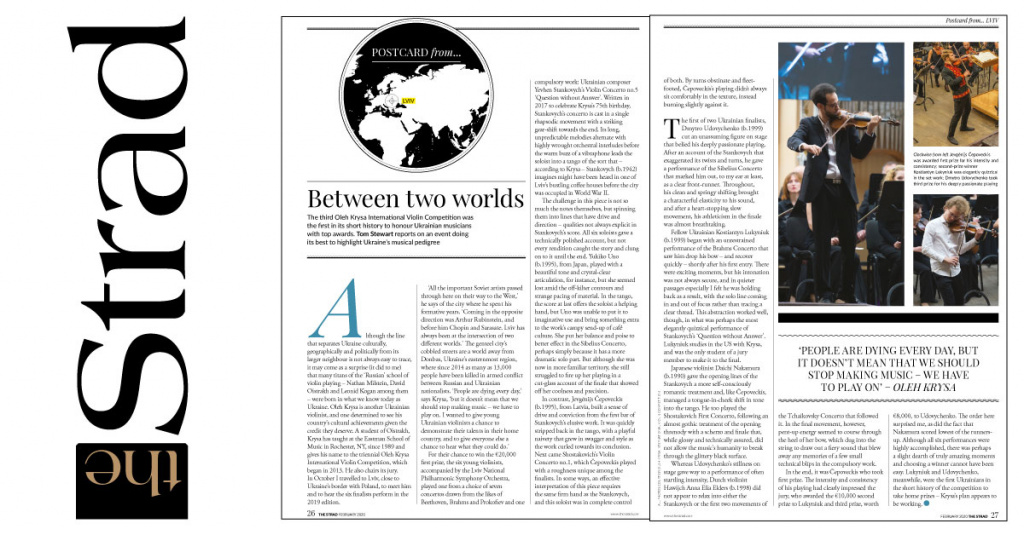
Between two worlds
https://www.thestrad.com/playing-and-teaching/between-two-worlds-postcard-from-lviv/9989.article
It is gratifying that thanks to our project - the Oleg Krysa International Violin Competition - the wide readership of the authoritative British magazine "The Strad", founded in 1890, which publishes articles about stringed instrument performers and academic music, not only learned about the competition, but also learned the true story. The magazine's music columnist Tom Stewart, who was present at the competition, notes in his article that the luminaries of violin art (Natan Milstein, David Oistrakh, Isaac Stern, Leonid Kogan, and others), who are commonly called students of the Moscow school, were born and educated in Ukraine, which still has talented teachers and students. This is evidenced by two prize-winning places of Ukrainian participants in the competition. Finally, you can read the translation of the article ("Between Two Worlds"), which thoroughly analyzes the performances of the finalists, which, unfortunately, we do not see in domestic music criticism.
The third Oleg Krysa International Violin Competition was the first in its short history to feature top prizes for Ukrainian musicians.
Tom Stewart reports on this event, which aims to highlight Ukraine’s musical lineage.
The line that culturally, geographically, and politically separates Ukraine from its larger neighbor is not always easy to trace, so it may come as a surprise (as it did to me) that many titans of the “Russian” school of violin playing, including Nathan Milstein, David Oistrakh, and Leonid Kogan, were born in what is now Ukraine. Oleg Krysa, also a Ukrainian violinist, decided to look at his country’s cultural achievements for the recognition they deserve. A student of Oistrakh, Oleg Krysa has taught at the Eastman School of Music in Rochester, New York, since 1989. He has agreed to lend his name to the International Violin Competition, which has been held every three years since 2013. He also heads the competition jury. In October, I traveled to Lviv, a city near the Ukrainian border with Poland, to meet him and hear the six finalists in the 2019 competition perform. “All the famous Soviet artists passed through this place on their way to the West,” he says of the city where he spent formative years. “There were also those who went in the opposite direction, like Arthur Rubinstein, and even earlier, Chopin and Sarasate. Lviv has always been at the crossroads of two different worlds. The cobblestone streets of the elegant city are a world far removed from Donbas, Ukraine's easternmost region, where 13,000 people have died in the armed conflict between Russians and Ukrainians since 2014. "People die every day," says Krysa, "but that doesn't mean we should stop making music - we should keep playing. I wanted to give young Ukrainian violinists the opportunity to showcase their talents in their home country, and for everyone else to hear what they are capable of."
Competing for the chance to win the first prize of 20,000 euros, six young violinists, accompanied by the Lviv National Philharmonic Symphony Orchestra, played a choice of seven concertos selected from works by Beethoven, Brahms, Prokofiev and other classical composers, and one mandatory piece - Violin Concerto No. 5 "Unanswered Questions" by Ukrainian composer Yevhen Stankovych. Written in 2017 to celebrate the 75th birthday of Oleg Krysa, Stankovych's concerto is composed in one rhapsodic movement with sharp changes in speed near the end. Its long, unpredictable melodies alternate with masterfully written orchestral interludes until the warm sound of the vibraphone leads the soloist into a tango similar to those that Stankovych (born 1942) imagined could be heard in one of the noisy cafés of Lviv before the city was occupied during World War II.
The difficulty in this work is not the notes themselves, but how to combine them into music full of movement and meaning - features that are not always evident in Stankovych's score.
All six soloists demonstrated technically perfect performances, but not all managed to capture the story behind the music and follow it to the end. For example, Yukiko Uno (born 1995) from Japan played with a beautiful timbre and crystal-clear articulation, but seemed to feel lost among the eccentric forms and unusual rhythm of the piece. In the tango, where the score finally lends a helping hand to the soloist, Uno failed to take the opportunity creatively to introduce additional mannered and pretentious nuances that would refer to the atmosphere of a café. Her poise and restraint led to a better result in the Sibelius concerto, perhaps simply because it has a more dramatic solo part. Despite the fact that in the performance of the second piece she was in more familiar territory, Uno failed to ignite the crystal facets of the final movement with her playing, in which the violinist showed coolness and precision of execution.
Quite different was the performance of Evgeniy Chepovetskis (born 1995) from Latvia, from the first bars of Stankovych’s elusive work filled with power and pressure, which quickly changed to playful naivety in tango and grew into mannerism and snobbery as the performer approached the final. Next was Shostakovich’s Violin Concerto No. 1, which Chepovetskis played with a brutality that the other finalists did not dare to. In a way, an effective interpretation of this work requires the same firm hand as the Stankovych concerto, and this soloist coped with both flawlessly. Chepovetskis’s sometimes wayward, sometimes smooth playing did not always fit comfortably into the texture, but instead created some contrast with it.
The unpretentious manner of the first of the two Ukrainian finalists, Dmytro Udovichenko (born in 1999), contrasted sharply with his deeply passionate playing. After Stankovych, where he highlighted and emphasized all the sharp turns, he moved on to the Sibelius concerto, which, at least to me, sounded like a serious bid for victory. Throughout the performance, his clean and elastic playing technique gave the sound a characteristic elasticity, the slow part almost stopped the heart, and the irrepressible energy of the finale simply took my breath away. The next Ukrainian participant, Kostyantyn Lukyniuk (born in 1999), began with a performance of the Brahms concerto, so unrestrained that shortly after the introduction he dropped his bow, but quickly picked it up and continued playing. There were moving moments, although his intonation was not always precise, which, especially in the quieter passages, left a certain lack of clarity and the solo line occasionally lost focus. However, this abstracted manner of performance worked well in Stankovych’s “Question Without an Answer,” which came out elegant and somewhat ironic. Lukyniuk is studying in the US with Oleg Krysa and was the only student of a jury member to make it to the final. Japanese violinist Daichi Nakamura (born 1990) gave the opening bars of Stankovych’s concerto a more self-consciously romantic interpretation and, like Čepovetskis, successfully changed the tone of the tango to a mocking-ironic one. He also performed Shostakovich’s First Concerto, but after the almost gothic sound of the opening threnody (the lament), in the scherzo and finale, the humanity of Shostakovich’s music was lost in the brilliant and technically impeccable technique of the playing.
While Udovichenko’s outward imperturbability on stage impressed with his stunning intensity, Dutch violinist Havih Anna Elia Elders (born 1998) remained tense in both the Stankovich concerto and the first two movements of the Tchaikovsky concerto. Only in the final movement did the pent-up energy finally burst from under the violinist’s bow, reproducing a sound so passionate that it made one forget about a few small technical gaps in the compulsory program.
In the end, it was Čepovetskis who received the first prize. The intensity and coherence of his playing impressed the jury. The second prize of 10,000 euros went to Lukyniuk, and the third prize of 8,000 euros to Udovychenko. This order surprised me, as did the fact that Nakamura scored the fewest points. While all six performances were highly accomplished, there were perhaps a few truly amazing moments, so choosing a winner could not have been easy. Meanwhile, Lukyniuk and Udovychenko became the first Ukrainians in the short history of the competition to receive awards - Krysa's plan seems to be working.
Clockwise from the left, Yevheniy Chepovetskyi was awarded first prize for the intensity and coherence of his performance; second prize winner Kostyantyn Lukyniuk was exquisitely ironic; Dmytro Udovychenko took third prize for his deeply passionate playing.
“People die every day, but that doesn't mean we should stop making music - we should keep playing,” - Oleh Krysa.